
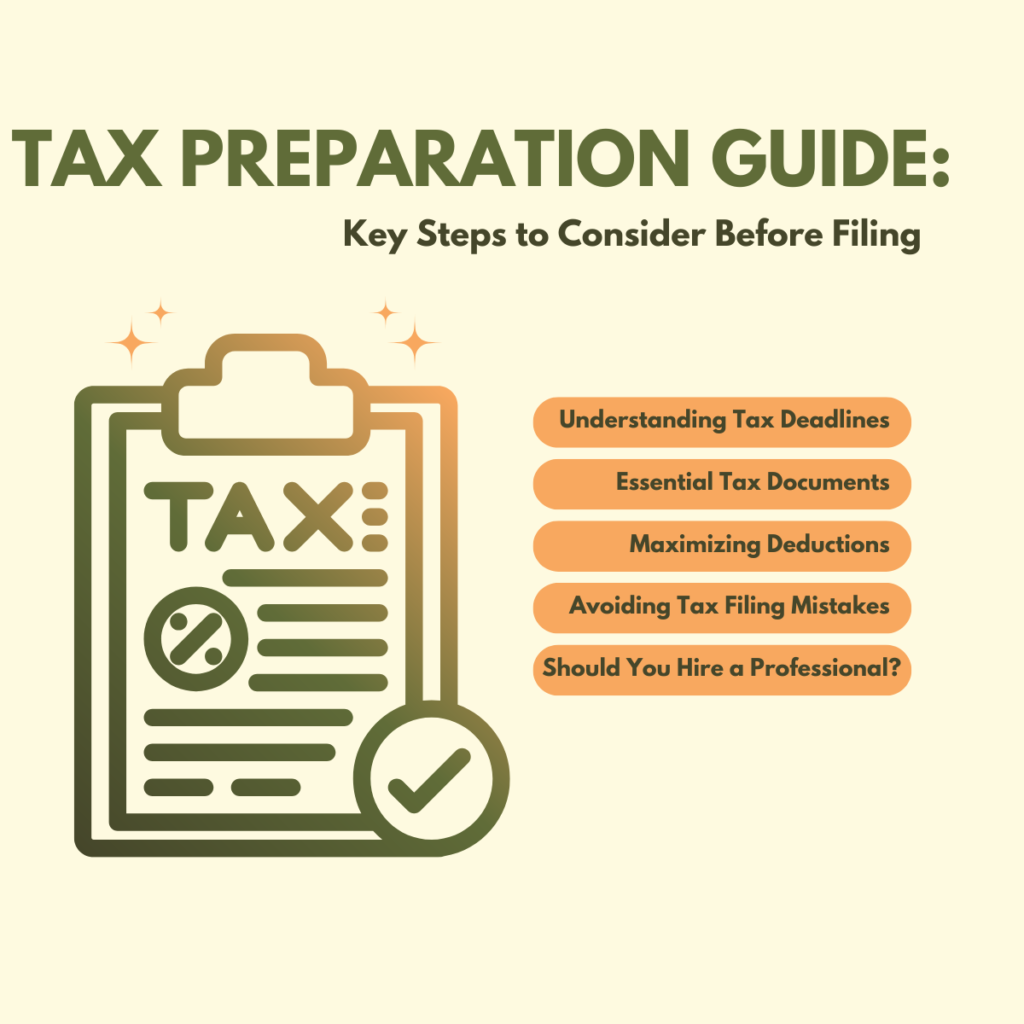
Tax season can feel overwhelming, but proper preparation can make the process smoother and even help you reduce your tax burden. Whether you’re filing as an individual or a business owner, understanding tax deadlines, deductions, and common pitfalls can help you file with confidence.
In this tax preparation guide, we’ll walk you through best practices for filing your taxes, key documents to gather, common mistakes to avoid, and strategies to potentially maximize your deductions. By the end, we hope you’ll feel ready to tackle your tax return—or know when to seek professional guidance.
Understanding Key Tax Deadlines
- January 27, 2025 – IRS officially starts accepting 2024 tax returns.
- April 15, 2025 – Deadline for filing individual tax returns (Form 1040) and paying taxes owed. This is also the last day to contribute to IRAs and HSAs for the 2023 tax year.
- October 15, 2024 – Extension deadline for those who filed Form 4868 to receive an automatic six-month extension.
Mark these dates on your calendar, and if you need additional time, file for an extension—but remember, an extension to file does not mean an extension to pay any taxes owed. For more official IRS guidance, check out this resource.
Tax Preparation Checklist: What Documents Do You Need?

Before you start filing, gather all necessary tax forms and other financial documents to ensure a smooth and accurate process. A well-organized approach can help you avoid mistakes and uncover potential tax-saving opportunities.
Essential Tax Documents
- Personal Information: Social Security numbers (SSNs) for you, your spouse, and dependents.
- Income Documents: W-2s (for employees), 1099s (for independent contractors, investment income, or retirement distributions), and any self-employment records.
- Deductions and Credits: Receipts and records related to charitable donations, business expenses, education expenses (Form 1098-T), mortgage interest (Form 1098), and medical expenses.
- Retirement Contributions: Documentation of contributions to IRAs, 401(k)s, or HSAs, which can impact your tax liability (Form 5498).
For a comprehensive tax preparation checklist, consider referring to NerdWallet’s guide.
Maximizing Deductions: Tax Strategies to Reduce Your Bill

One of the most effective ways to lower your tax liability is by maximizing your tax deductions and credits. Here are some of the most common ones:
Common Tax Deductions
- Retirement Contributions: Contributions to traditional IRAs, 401(k)s, and HSAs can be deducted from taxable income.
- Homeownership Deductions: Mortgage interest and property taxes can offer significant savings.
- Charitable Contributions: Donations to qualified charitable organizations can be deducted if you itemize.
- Medical and Dental Expenses: If your medical expenses exceed 7.5% of your adjusted gross income (AGI), you may be able to deduct them.
Valuable Tax Credits
- Child Tax Credit (CTC): Up to $2,000 per qualifying child under age 17.
- Earned Income Tax Credit (EITC): A refundable credit for low- to moderate-income individuals.
- American Opportunity and Lifetime Learning Credits: Education-related tax benefits for college students.
- Residential Energy Credits: This credit applies to renewable energy sources like solar panels. The credit amounts vary but can cover up to 30% of eligible costs.
- Electric Vehicle (EV) Tax Credit: Provides up to $7,500 for new qualified EVs and up to $4,000 for used EVs. Please keep in mind that this is subject to income limits and vehicle qualifications.
Tax deductions reduce your taxable income, lowering the amount subject to tax, while tax credits are like gold because they provide a dollar-for-dollar reduction in the taxes you owe. A $1,000 deduction might save you $220 in taxes, but a $1,000 tax credit saves you the full $1,000, making credits far more valuable for maximizing your tax savings.
For a deeper dive into tax planning strategies, explore this guide from The Lynch Financial Group.
Avoiding Common Tax Filing Mistakes

Even a small error on your tax return can lead to processing delays or trigger an IRS audit. Here are some of the most common mistakes taxpayers make—and how to avoid them.
Filing with Incorrect or Missing Information
- Always double-check your Social Security number, income, and deductions before submitting.
- Make sure all W-2s and 1099s match the IRS records.
Choosing the Wrong Filing Status
- Your filing status (single, married filing jointly, head of household, etc.) impacts your tax bracket and deductions.
- If unsure, use the IRS’s Filing Status Tool or consult a tax professional.
Not Claiming All Eligible Deductions and Credits:
- Many taxpayers miss out on student loan interest deductions, medical expense deductions, and energy-efficient home credits.
Forgetting to Sign or E-File Your Return
- An unsigned paper return is invalid. If filing electronically, verify your e-signature (AGI or PIN from the previous year) to avoid rejection.
For more tips on filing your taxes correctly, check out Experian’s tax filing tips.
Should You File Your Own Taxes Or Hire a Professional?

Consider Filing on Your Own
- When you have mostly W-2 income and no significant deductions.
- When you’re comfortable using tax software (like TurboTax or H&R Block).
Consider Hiring a Tax Professional
- When you own a business, have rental income, or work as a freelancer.
- When you experienced major life changes (marriage, divorce, having a child, inheritance).
- When you want to implement tax-efficient investment strategies or ensure you’re maximizing deductions.
Working with a financial advisor can also help with the tax management of your financial plan (long-term tax planning), helping ensure your investments, retirement accounts, and estate plan are set up in a way to reduce your lifetime tax bill.
Take Control of Your Tax Strategy Today

Tax season doesn’t have to be stressful. By using this tax preparation guide, following best practices for tax filing, staying informed on deductions and credits, and avoiding common mistakes, you can file with confidence and maximize your financial outcomes.
If you need personalized tax planning strategies, a financial advisor can help integrate tax efficiency into your broader financial plan. Schedule a consultation with The Lynch Financial Group today to explore how we can help you minimize taxes, increase income and reduce your lifetime tax bill.
Frequently Asked Questions (FAQ) About Tax Preparation
1. Can I file my taxes for free?
Yes! There are several options for filing your taxes at no cost, depending on your income level and tax situation. The IRS offers Free File, a program that provides free tax preparation software for those with an adjusted gross income (AGI) of $84,000 or less. Additionally, some tax preparation companies offer free filing for simple tax returns. For more details on how to file your taxes for free, check out this guide from CNBC.
2. What happens if I miss the tax filing deadline?
If you miss the April 15 deadline and owe taxes, you may face penalties and interest charges. However, if you are due a refund, there is typically no penalty for filing late. If you need more time, you can file for an extension, which gives you until October 15 to submit your return—but you must still pay any estimated taxes owed by April 15 to avoid penalties.
3. Should I take the standard deduction or itemize?
The standard deduction is a set amount that reduces your taxable income, while itemizing allows you to deduct specific expenses such as mortgage interest, medical costs, and charitable donations. Generally, if your total itemized deductions exceed the standard deduction, itemizing may save you more money. If you’re unsure, a tax professional can help determine the best option for you.
